

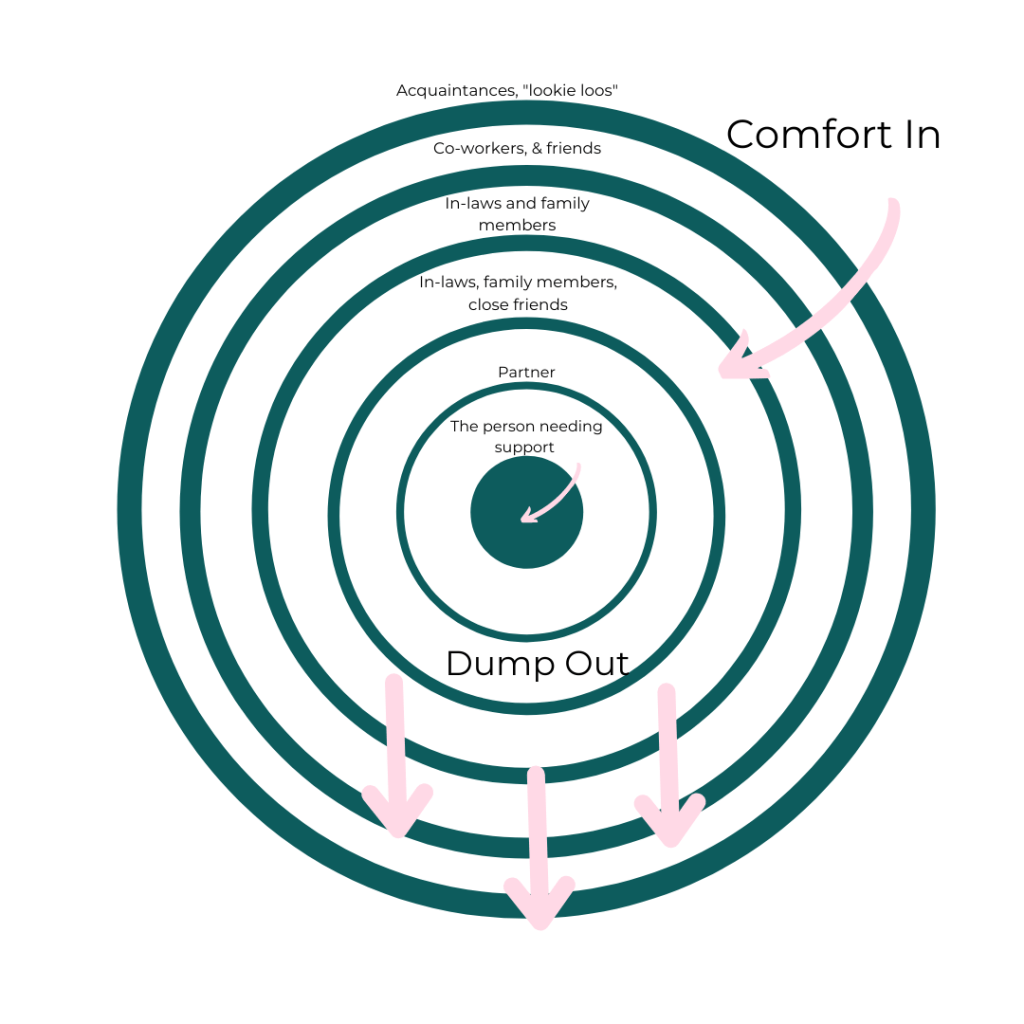
There is a theory that was created by Susan Silk, a clinical psychologist and her friend Barry Goldman. They created it after Susan’s experience with breast cancer and having people say hurtful, and unhelpful things, with good intentions. This theory is helpful in that it can tell one how to react and what to say or do depending on their spot in the ring.
You would first start by writing the name of the person who is in need in the middle of the ring, then you would slowly add peoples names to the ring starting closes to the middle person (partner for example) and work your way out, children and parents before more distant relatives, close friends before co-workers etc. You would add as many rings as you need. This helps you figure out what is called the Kvetching Order.
The main idea behind the Ring Theory is to protect the person in the middle of the circle by allowing comfort in, and dump out. The person in the middle is allowed to cry, complain and vent about any and everything as much as they want, without anyone complaining back to them about their problems. The people in the larger circles are allowed to vent or complain as well, but only to people in larger circles than them. The only correct way to deal with the person in the middle ring is with comfort, understanding or empathy and care.
For example, say your sister just had a baby. Everything went “fine” and she and the baby are healthy. However, she calls you, crying about how the baby doesn’t seem to want to stop latching and she just needs some sleep. She also may mention some situations during the birth experience she wasn’t happy about, maybe she had an episiotomy, or felt pressured into an epidural. Instead of saying something like “well you and the baby are safe and healthy and that’s the main goal” or “well give the baby a soother or let someone give them a bottle,” validate those feelings. Something like “I am sorry you are feeling like this. It sounds so hard, and I wish I could help you in some way. Can I bring you some food? How can I help? Do you need me just to listen, or come sit with you and keep you company while you nurse?”
Saying things like “Just you wait till…” during pregnancy, or “you will miss these days when they’re gone” to someone who is in crisis (even if you don’t think they are) can be so damaging to the relationship and the person’s mental state. It can make them feel more alone, and more hopeless, when you just wanted to encourage them and make them feel better. The ring theory is great at helping us know how to support someone, whether we deem them in a crisis or not.
We don’t know where others are in their lives, and if someone is complaining and crying out, maybe we need to look at the situation and use the Ring Theory. Especially after something like birth. Birth is not an emergency, but it is mentally, physically and spiritually exhausting. Using the ring theory can help us deal with our own trauma and crisis as well as help us help others and be a safe person in their life.
The fourth trimester is a vulnerable place to be, full of emotions, exhausting, sweet baby cuddles, healing, bonding and learning. Lets learn to support those going through hard times in a safe, healing way.
 Beyond Measure Doula Services
1 thought on “The Ring Theory for Postpartum”